|
Einstein - Particles, Waves
and
the Photoelectric Effect
a
World
Without Einstein Series
Einstein
solved the mystery of the photoelectric effect, showed that light is
both a particle and a wave, and enabled a vast array of
photo-detecting
devices.
After
you have enjoyed the broadcast, get the book! All of the information
presented here, and more, can be found in World
without Einstein
|
 |
|
|
Image
#1
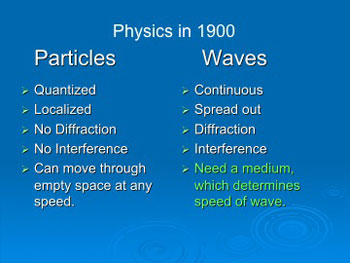
In 1900, everyone “knew” particle and waves were
completely different phenomena.
|
|
|
|
Image
#2
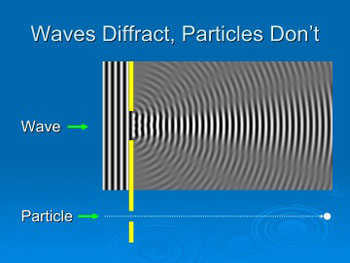
Waves
diffract after passing though a hole in a barrier; particles don’t.
|
|
Image
#3
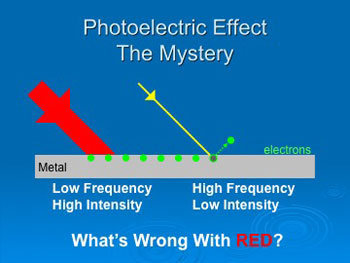
Light was known to knock electrons out of metals,
but why only sometimes? Only the wave’s total energy should matter, but
red light was ineffective even at high intensity.
|
|
|
|
Image
#4
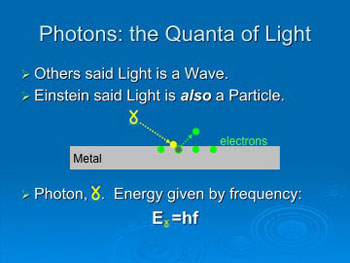
Einstein
said light is made of particles, “photons”. Only one photon can hit an
electron at one time, and only if that photon’s energy is high enough
is the electron knocked out. It takes one good whack; a thousand nudges
won’t do. Yellow light has high frequency and thus high energy; red
doesn’t.
|
|
Image
#5
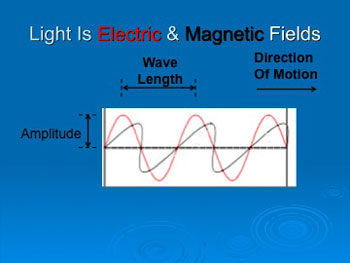
Light
is composed of an electric and a magnetic field that wave in
perpendicular directions. Nothing material moves; no medium is required
for a light wave.
|
|
|
Image
#6
Objects sometimes seem more wave-ish or
particle-ish, but everything really is both. This particle-wave duality.
|
|