|
|
|
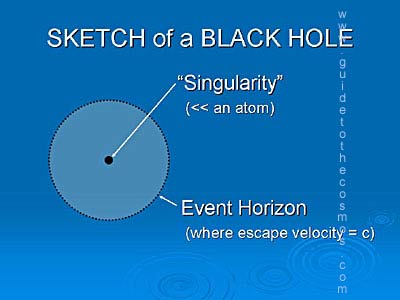
This
sketch shows the two parts of a black hole: the central singularity and
the event horizon. The singularity contains all the black hole’s mass
in a volume much smaller than a single atom. The event horizon is the
limit of what we can see from the outside. Inside the event horizon,
the escape velocity exceeds the speed of light, thus nothing inside can
ever escape, not even light,
|
|
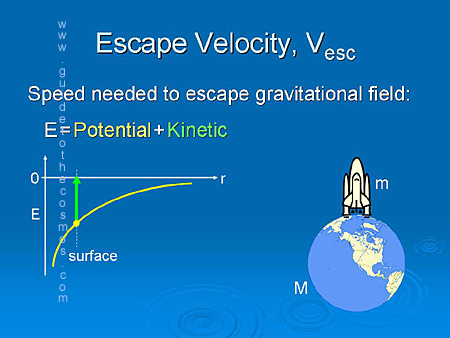
How
a rocket can
overcome its negative potential energy with sufficient kinetic energy
to allow it to escape a gravitational field
|
 |
|
|
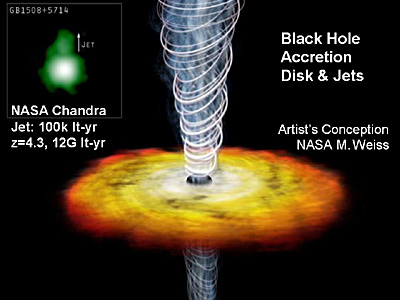
Material
from interstellar gases, stars, etc., is pulled toward the central
black hole accumulating in an "accretion disk".
About
75% of the material will eventually fall into the black hole, while 25%
will be ejected along the spinning black hole's north and south poles,
forming immense jets, some longer than our Milky Way galaxy.
|
|
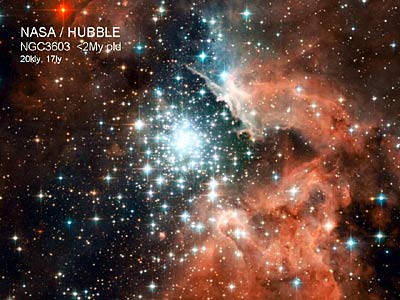
Cluster
of new stars less than 2M years old.
|
 |
|
|
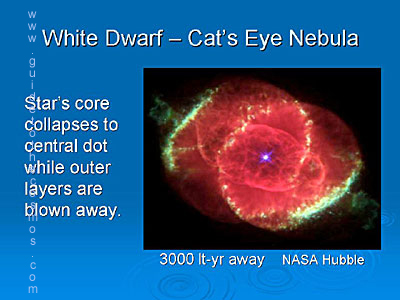
When
lower mass stars run out of fuel, the core collapses in an immense
implosion, creating a White Dwarf, the central white dot, and blowing
the star's outer layers off into space, creating beautiful nebula.
|
|
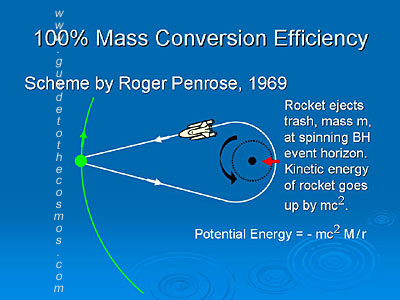
Penrose's
scheme to achieve 100% mass
conversion efficiency with a spinning black hole. The rocket dumps
material, which could be trash, at the event horizon and returns to an
orbiting society (shown in green) with excess energy = mass of trash
times c2.
|
 |
|
|